A friend recommends your company. A potential customer opens your website, likes the service description, then clicks About.
They are not necessarily looking for your founding story. They may be checking something more practical: Who will I actually work with? Do these people have relevant experience? Is this a real business I feel comfortable contacting?
If the answer is three paragraphs about passion and excellence, you have given them enthusiasm when they needed evidence.
A useful small-business About page helps someone verify who you are, understand how you work, and take the next step with fewer doubts. Here is how to build one without turning it into a corporate autobiography.
Start with the questions customers ask before they trust you
Your service pages explain the work. Your About page should explain the people and business responsible for delivering it.
Before writing, ask whoever handles inquiries which questions come up before a customer agrees to proceed. Look for questions like these:
- Who owns or runs the business?
- Will I work with the person pictured here?
- Have you handled situations like mine?
- Are your qualifications relevant to the service I need?
- Are you local, remote, or a mix of both?
- What happens after I contact you?
Choose the three or four questions that matter most to your buyers. Those questions become the page brief. Your company timeline can wait its turn.
Put a clear business introduction before the origin story
Someone arriving directly on your About page should not need to visit the homepage to understand the business.
Open with your business name, what you do, who you serve, and where or how you operate. Then introduce the person or team accountable for the work.
Instead of this
“We are a passionate team committed to innovative solutions and exceptional service.”
Try this structure
“[Business name] provides [specific service] for [customer type] in [service area or delivery format]. [Name and role] leads the business and oversees [relevant responsibility].”
This is a writing template, not a claim to copy unchanged. Fill it with facts you can stand behind. A two-person bookkeeping firm does not need to sound like a multinational consultancy to be credible.
Show who does what, not just who founded the company
A founder biography can be interesting and still leave customers confused about the working relationship.
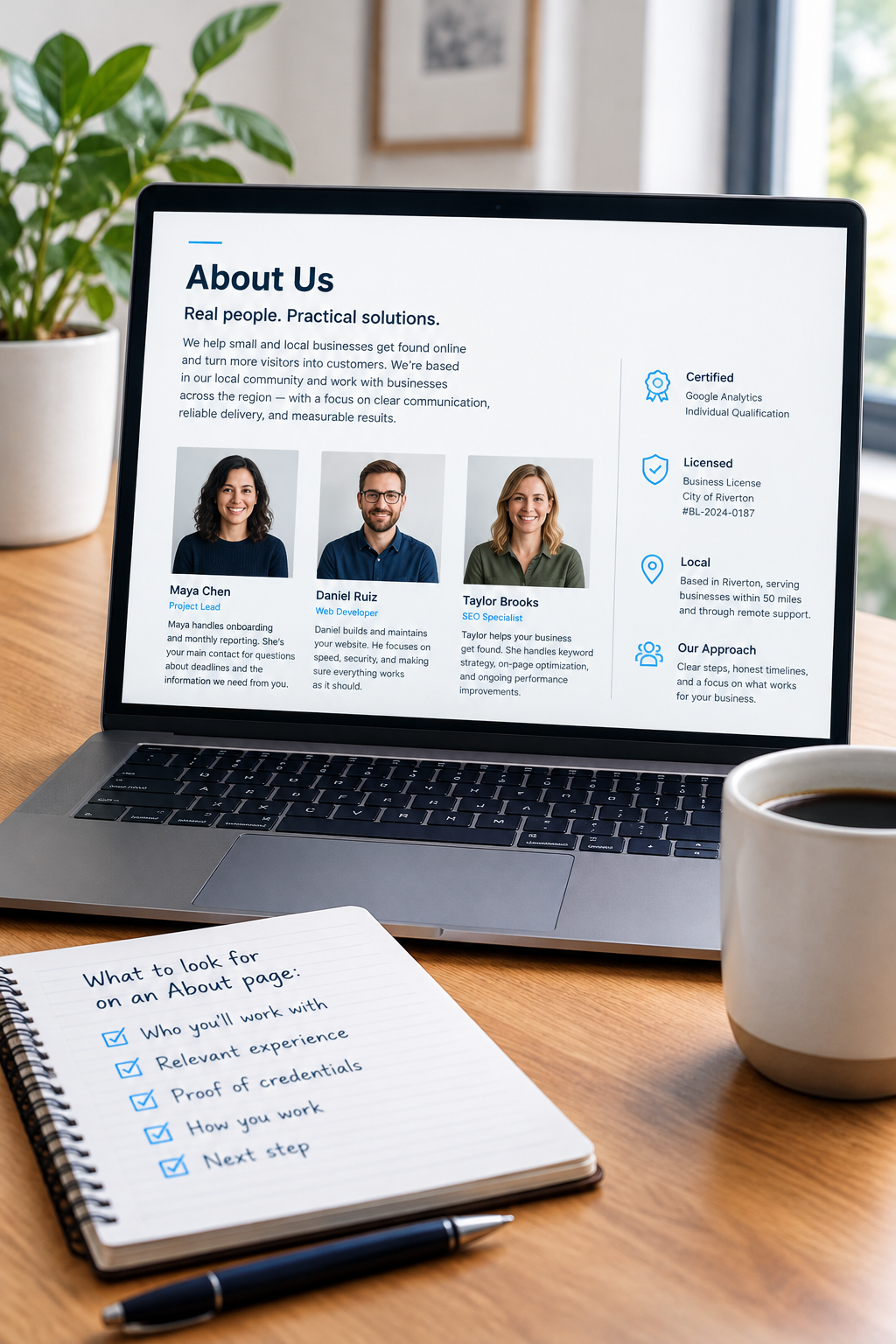
For each customer-facing person you feature, include their name, role, relevant experience, and involvement in the customer's work. A short, useful biography usually beats a full career history.
For example, an illustrative team description might read: “Maya leads onboarding and monthly reporting. She is your main contact for questions about deadlines and the information we need from you.”
Only use that kind of wording if it reflects the actual arrangement. If the founder handles sales but another team delivers the service, explain the handoff. If specialists or subcontractors contribute, describe the arrangement where it matters to the buying decision.
Being small is not the problem. Creating the wrong expectation is. Solo operators can explain their direct involvement without using vague references to a large team.
Make credentials specific enough to check
“Qualified professionals” asks the reader to take your word for it. A named qualification gives them something more concrete.
Where relevant, state the credential, who holds it, the issuing organization, and what it relates to. Link to an official verification record when one is available and appropriate.
- Licenses: Identify the licensed person or business and the applicable jurisdiction. Include identifiers where required or appropriate.
- Certifications: Use the correct designation and explain its relevance in plain language.
- Memberships: Describe them as memberships, not endorsements or certifications.
- Experience: Distinguish the age of the business from an individual's prior experience.
A business founded two years ago can have an owner with fifteen years of relevant experience. Say that clearly rather than implying the company itself has operated for fifteen years.
Check current status before publishing. Use credential logos only when permitted, and do not imply that a qualification covers services outside its scope. Regulated businesses should have the wording reviewed against their applicable professional requirements.
Use real photos with a clear purpose
A genuine portrait can help customers recognize the person they will meet. A workplace photo can explain where appointments happen. A team photo can show the people behind the service.
Choose images that answer a question rather than simply fill a rectangle.
Do not present stock models as your staff or a stock office as your premises. If you work remotely or visit customers, explain that arrangement. You do not need a public storefront to describe a legitimate business accurately.
Get permission before publishing identifiable people, customer locations, or other private details. Check backgrounds for documents, screens, addresses, and anything else that should not be public. A tidy photo is nice. A photo without someone's account details in the background is better.
Explain what your working style means for the customer
Values become useful when they describe something a customer can expect.
“We believe in communication” is broad. “You receive a written scope before work begins, and we discuss changes before proceeding” describes a practice someone can understand.
Pick two or three practices you consistently follow. Depending on your business, these might explain:
- Who answers questions during the work.
- How you agree on scope and handle changes.
- How you coordinate with a customer's existing team.
- What you do when a request falls outside your expertise.
Avoid promising response times or access your team cannot reliably provide. This section should describe how you operate today, not how you hope to operate after the next hire.
Give the story a job, then give the reader a next step
Your origin story belongs on the page when it explains a meaningful choice: why you serve a particular industry, why you specialize, or why you organize the service differently.
Keep the details that help a buyer understand your approach. Trim the milestones that matter mainly inside the business.
Then connect the page to an appropriate action. Someone still researching may need a link to the relevant service. Someone ready to talk needs a clear inquiry route and an honest explanation of what follows.
For example: “Tell us which service you are considering. We will review your inquiry and explain whether an introductory conversation is the right next step.” Use this only if it matches your process.
Your About page does not need to repeat every service, review, or project story. Link to that supporting material rather than turning the page into a second homepage.
Test whether the page answers the trust question
Ask someone unfamiliar with your business to read the page, then close it. Can they explain what you do, who is responsible, what relevant evidence you provided, and how to proceed?
If they remember your founding year but cannot say who they would work with, revise the page.
For a manageable first update, publish a clear introduction, one useful owner or team section, verified credentials where relevant, and a next step. Assign someone to check it when roles, qualifications, or working arrangements change.
Want a second pair of eyes? Get website feedback from SolcoMedia on whether your About page answers the questions a prospective customer would reasonably ask before contacting you.