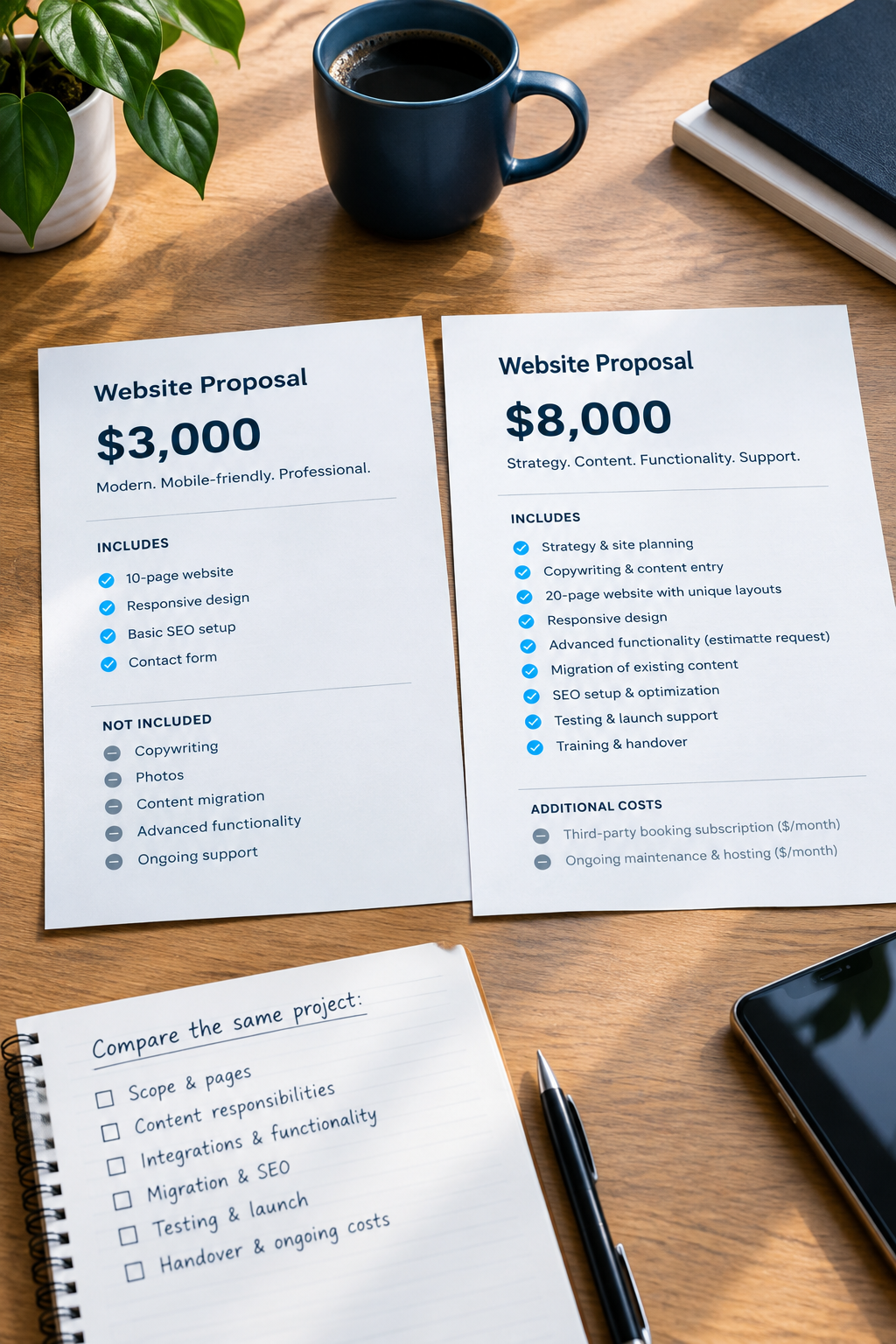
One website quote says $3,000. Another says $8,000. Both promise a professional, mobile-friendly website.
So what does the extra money buy?
Maybe research, copywriting, migration, and testing. Maybe more complicated functionality. Maybe nothing your business actually needs. The headline price cannot answer that question.
Before comparing prices, make sure you are comparing the same project. A useful website quote should tell you what will be delivered, what your team must supply, how completion will be judged, and what happens after launch.
Start with one business outcome, not a wish list
Write a short project brief and give it to every provider you are considering. Otherwise, each provider will price their own interpretation of your request.
For example: “We want homeowners in our service area to understand our three main services and submit a useful estimate request. Our current site mixes those services together, and our office repeatedly asks leads for missing job details.”
That is more useful than “We need a modern website.” It gives providers a reason to recommend specific pages, content, and functionality.
Include:
- The main customer action: Call, request an estimate, book, or buy.
- The current obstacle: What customers or staff struggle with today.
- The essential scope: Services, locations, products, and integrations that must be included.
- Your constraints: Budget range, preferred launch date, and staff availability.
- What already exists: Usable copy, photos, branding, accounts, and website content.
Keep optional ideas separate. A customer portal might be useful someday, but it should not quietly become a requirement for launching five service pages.
Translate each quote into the same scope sheet
Create a document with the headings below. Under each heading, record what each provider includes, excludes, or leaves unclear. Mark missing details as “needs clarification,” not “probably included.”
Pages and reusable layouts
“Ten-page website” sounds specific until you ask which ten pages. Request a page list and clarification about unique layouts versus pages built from a shared template.
Also ask who decides the navigation and page structure. Building pages you specify is different from helping you work out which pages customers need.
Copy, photos, and content entry
Does “content included” mean writing new copy, editing your draft, or pasting in text you supply?
Confirm who gathers service details, interviews your team, selects images, checks usage rights, and enters the content. If those tasks belong to you, they still have a cost: staff time.
AI-assisted writing does not remove the need for someone to verify services, prices, credentials, and business claims. Ask who approves accuracy before publication.
Customer actions and integrations
“Contact form” could mean a basic message box or a structured estimate request connected to your customer management system.
Describe the actual behavior you need. For example: “The visitor selects a service, provides a postcode and job description, receives an acknowledgment, and the office receives the inquiry.”
Ask whether booking tools, payments, CRM connections, and notification setup are included. Separate the provider's setup fee from any ongoing third-party subscription.
Existing content and search continuity
For a replacement website, establish what happens to existing pages, downloads, links, and useful content. Ask who inventories old URLs and handles redirects where appropriate.
“SEO included” needs unpacking too. It might refer only to basic page titles and descriptions, or it might include keyword research, content planning, and technical checks. Those are different workloads. None guarantees rankings.
Testing and launch
Ask what will be checked before launch and who signs off. Useful checks include mobile layouts, navigation, form delivery, booking behavior, keyboard access, and essential tracking.
Testing should have an agreed scope. “Accessibility included” is not the same as a documented accessibility evaluation, and a performance target needs defined pages and test conditions.
Also clarify who connects the domain, manages the launch, and checks that existing business email remains unaffected.
Handover and ongoing costs
List hosting, maintenance, software licenses, support, and any minimum contract term. Ask what happens if you cancel or move to another provider.
Confirm which accounts your business controls, what editing access you receive, and whether training is included. You do not need to become a developer, but you should understand your responsibilities.
Compare the launch-ready cost, not just the build fee
A cheaper build may still be the right choice. The trick is knowing what else you must arrange to make it usable.
Use this simple comparison:
Launch-ready cost = quoted build fee + required extras not included in the quote.
Then record first-year recurring costs separately, including when billing begins. Note taxes where applicable and keep optional upgrades out of the essential total.
For illustration, a lower-priced quote might require your business to supply all copy, purchase a booking subscription, and arrange content migration separately. A higher-priced quote might include writing and migration but use that same paid booking subscription. Neither is automatically better. The question is whether the difference covers work you need and cannot comfortably handle yourself.
Do not invent a precise price for staff time if you cannot estimate it reliably. Instead, list the tasks and identify who has capacity to do them.
Check the approval process before accepting the timeline
A six-week timeline is not very helpful if it assumes you will deliver approved copy tomorrow.
Ask each provider:
- What must we supply before work starts?
- Which milestones need our approval?
- How many revision rounds are included, and what counts as a round?
- What happens if feedback or content arrives late?
- How are extra requests priced and approved?
- What triggers each payment?
Choose one person in your business to consolidate feedback. Five colleagues sending contradictory edits can turn a straightforward project into an expensive group chat.
A change request should explain its cost and schedule impact before you authorize it. That protects both sides from surprise expectations.
Agree on what “finished” means
Visual approval alone does not establish that a website is ready for business. Ask for observable acceptance criteria that match your brief.
For the estimate-request example, those might include:
- The agreed service pages contain approved content.
- Visitors can complete the estimate form on the agreed mobile and desktop test setups.
- Test inquiries reach the designated destination and display the expected confirmation.
- The agreed old URLs redirect to appropriate destinations.
- Your nominated team member receives editing access and handover instructions.
These are deliverables a provider can demonstrate. “The website will double our leads” is not a sensible acceptance criterion because lead volume also depends on demand, traffic, competition, and your offer.
Clarify the post-launch correction period too. Fixing an agreed feature that does not work is different from adding a feature nobody scoped.
Send one clarification email, then make the decision
You do not need a procurement department. You need the important unknowns answered in writing.
Try this:
“Thanks for the proposal. Before we decide, please confirm the page list, content responsibilities, integration setup, migration work, testing scope, handover, and recurring fees. Please also identify our required inputs, the revision allowance, and how additional work is approved. If anything essential to our brief is excluded, please price it separately.”
Then choose based on fit: the necessary scope, a manageable workload for your team, a clear process, and a cost you can sustain.
If a provider leaves material questions unanswered after clarification, that uncertainty belongs in your decision. A polished proposal cannot substitute for a shared understanding of the work.
Your next step: Put your business brief beside each quote and highlight anything that is required but unpriced, unassigned, or undefined. Resolve those items before paying a deposit.
Planning a website project? Discuss a Project with SolcoMedia. Bring your goals, must-haves, and constraints so the conversation starts with the work your business actually needs.