Many small-business websites have a page called “Services” that lists everything the company does. It may be accurate. It may even look perfectly nice. But it often asks a customer to do too much work.
A person searching for a specific problem, such as emergency AC repair, estate planning, commercial cleaning, or kitchen remodeling, wants to quickly answer a few practical questions: Is this the right business for my need? Do they work in my area? What happens next? Can I trust them?
A single catch-all services page rarely answers those questions well. Strong service pages do. They make it easier for the right prospects to understand the offer, feel confident, and take the next step. They also give search engines clearer context about what your business actually provides.
The problem with the one-page services list
A general services page is useful as an overview, but it should not be the end of the journey. When every service gets one sentence or a bullet point, important details disappear.
- A homeowner cannot tell whether you handle their particular type of project.
- A buyer cannot see what makes your approach different.
- A visitor may not know whether the service is available in their location.
- Your team receives vague inquiries because the website did not set expectations.
- Search engines have little focused information to connect with a specific search.
This does not mean every tiny variation needs its own page. “Drain cleaning,” “clogged drain,” and “unclog a drain” do not need three nearly identical pages. The goal is a clear page for each meaningful service or customer need, not a small army of thin pages wearing fake mustaches.
Decide which services deserve their own page
Start with the services that matter most to the business, not simply the longest list of things your team can do. A dedicated page is usually worthwhile when a service has its own buyer intent, process, audience, value, or search demand.
Prioritize pages using four questions
- Is it a meaningful revenue driver? Focus first on services that create profitable work or open the door to valuable long-term customers.
- Do customers ask about it specifically? If prospects regularly call asking whether you offer something, that service needs a clearer explanation online.
- Is the decision process different? A page for residential work may need different proof, timing, and calls to action than commercial work.
- Would someone search for it by name? Think in customer language, not internal department labels.
For example, a remodeler may need separate pages for kitchen remodeling, bathroom remodeling, and home additions. A professional services firm may need pages for tax preparation, bookkeeping, payroll, and advisory services. Each service solves a different problem and requires different information before a visitor is ready to contact the business.
Build each page around a customer decision
A useful service page is not a sales brochure stretched to fill a screen. It is a decision-support page. It should help a qualified prospect decide whether to continue with you.
1. State the service and the outcome clearly
Open with a direct heading that names the service in plain language. Follow it with a short explanation of who it is for and what the customer can expect.
Instead of: “Comprehensive solutions designed around your needs.”
Try: “Commercial cleaning for offices and facilities that need dependable recurring service, clear communication, and a plan built around your schedule.”
The second version gives a visitor something to recognize. It also gives the business a chance to position itself without vague claims.
2. Explain the situations you handle
Customers often arrive with a problem, not a service-category label. Include a short section that connects your offer to real situations.
- Starting a new project or opening a new location
- Replacing an outdated system
- Fixing an urgent issue
- Maintaining an existing asset
- Getting advice before making a larger decision
Be specific enough to be helpful, but do not promise work you cannot perform. If a job falls outside your scope, say so. Clear boundaries improve lead quality and save your team from awkward calls later.
3. Show how the process works
Uncertainty slows decisions. A simple process section can remove much of it. Explain what happens after someone reaches out, what information you need, whether an on-site visit is required, and what they can expect next.
Keep the process honest. If estimates typically require a site visit, say that. If response timing depends on job urgency or business hours, explain that too. Specificity is more reassuring than a promise that sounds great but means nothing.
4. Add proof that belongs to that service
Service-specific proof is more persuasive than a generic wall of compliments. Use relevant testimonials, project examples, certifications, team experience, photos of real work, or a concise explanation of your standards.
For instance, a landscaping company’s retaining-wall page should show retaining-wall work, not only lawn-mowing photos. A law firm’s business formation page should answer business formation questions, not rely entirely on a general firm biography.
5. Make the next step match the service
The call to action should fit how that service is purchased. A simple contact form may work for a consultant. A contractor may need a “Request an estimate” path that asks for location, project type, and timing. An urgent repair service may need a prominent phone option.
Use one primary next step and make it easy to find. You can offer a secondary option, but avoid giving visitors a row of equally important buttons and hoping they pick one.
A practical service-page structure
You do not need to use every section on every page. This is a dependable starting structure for most service businesses.
- Clear headline: Name the service and the main outcome.
- Who it is for: Describe the customers, properties, organizations, or situations you serve.
- What is included: Explain the scope in plain language.
- Why choose your approach: Share relevant differentiators, credentials, process, or standards.
- How it works: Outline the next few steps.
- Proof: Add relevant reviews, examples, photos, or credentials.
- Service area: Clarify where you work when geography matters.
- Questions customers ask: Answer a few honest, high-value questions.
- Call to action: Tell visitors exactly what to do next.
Do not create pages just to create pages
More pages are not automatically better. Pages become a liability when they are copied from one another, thin on useful details, or built around every possible keyword variation.
Before publishing a new service page, ask whether it gives a customer information they could not get from another page. If the answer is no, combine the topics or improve the existing page instead.
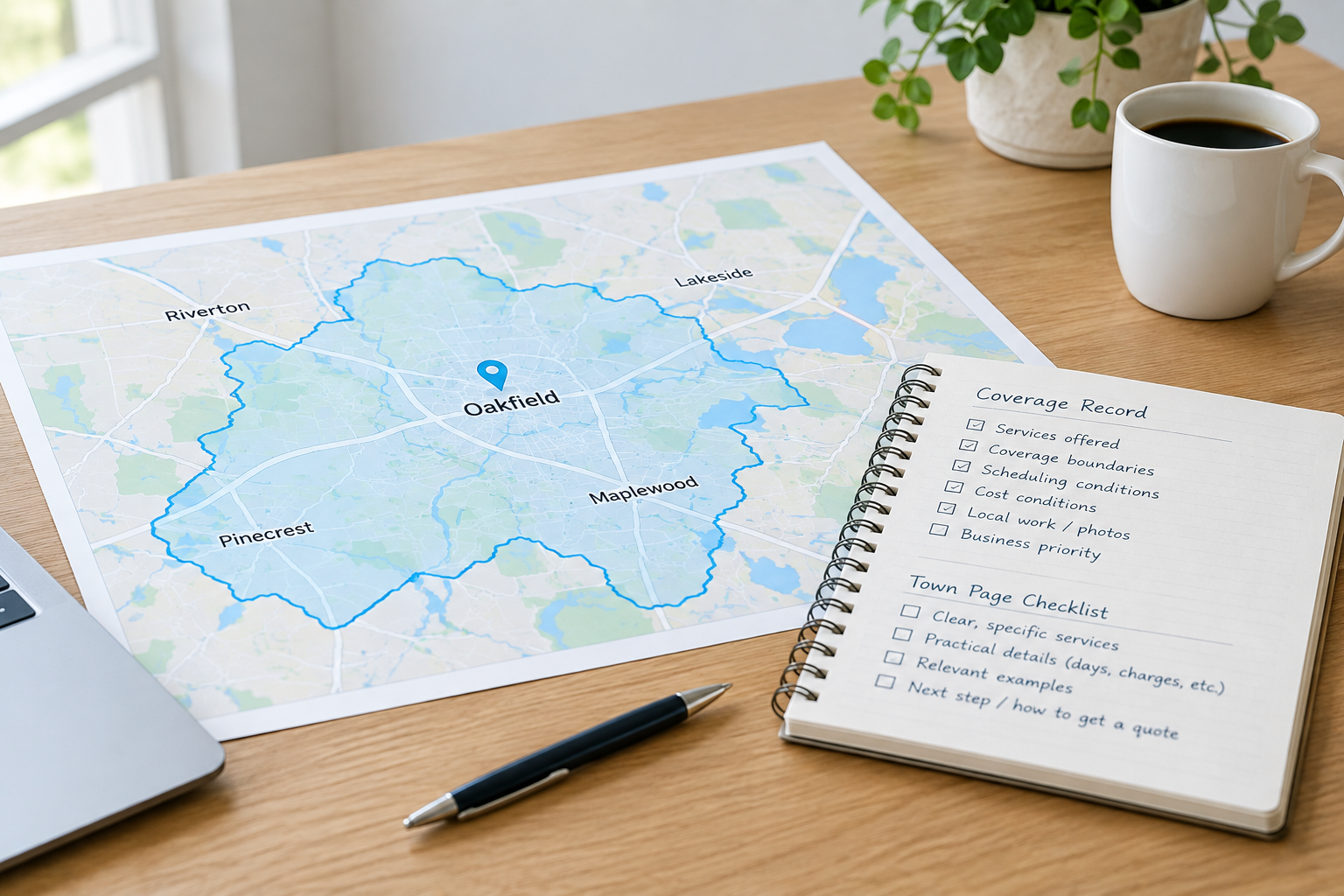
Also avoid making location pages that merely swap one city name for another. If you serve multiple areas, each location page should include genuinely useful local context, such as the services offered there, service coverage, local project examples where appropriate, or practical details about how you work in that area.
Connect the pages so customers can keep moving
A service page should not be a dead end. Link to nearby information that helps visitors make progress.
- Link from the main Services page to each core service page.
- Link from relevant blog posts to the service that solves the reader’s problem.
- Link to related services when customers commonly need both.
- Link to project examples, reviews, team pages, and contact options where they support the decision.
- Make sure navigation labels use language customers understand.
These connections make the site easier to use. They also help important pages avoid getting buried three or four clicks away from the homepage.
Review your current pages in 30 minutes
Open your website on a phone and choose one service you want more of. Then check the page as if you were a new customer.
- Can you tell within a few seconds what the service is and who it is for?
- Does the page explain the problem it solves?
- Can you see what makes your business a sensible choice?
- Are scope, process, or service area clear enough to set expectations?
- Is there proof that relates to this service?
- Is the next action obvious and easy to complete?
- Can you reach the page from the main navigation or Services page without hunting?
If several answers are no, start with one high-priority service rather than attempting a full site rewrite. Improve the page, connect it to the rest of the site, and use what you learn to guide the next one.
The goal is better-fit conversations
Service pages are not just an SEO task or a writing task. They are a way to make your website do more of the explaining before your team gets involved. When customers can understand the offer, see relevant proof, and know what to expect, the inquiries that arrive are more likely to be informed and appropriate.
Your website does not need a page for every phrase someone might type into a search bar. It needs clear, useful pages for the work your business most wants to win.
If your core services are hard to find or hard to understand, a website review can identify the highest-impact pages to improve first.