“Should we put pricing on the website?” sounds like a simple yes-or-no question. It is usually a question about sales process, customer fit, and what happens before someone is ready to contact you.
Many service businesses avoid the topic because every job is different. Fair enough. A custom remodeling project, legal matter, managed IT agreement, or commercial cleaning contract may not have one honest flat price.
But hiding every hint of cost can create a different problem: qualified prospects do not know whether you are in their range, what affects the investment, or whether contacting you will be worth their time. They leave with uncertainty, while your team spends time sorting through inquiries that were never a fit.
The useful question is not “Do we publish a price list?” It is how much pricing context does a buyer need to take the next step with confidence?
Start with the job your website needs to do
A website does not need to close every sale. For many service businesses, its job is to help the right person understand the offer, decide they are a plausible fit, and begin a productive conversation.
Pricing information can support that job in three ways:
- It qualifies inquiries. People with a clearly incompatible budget can opt out before filling out a form.
- It builds trust. A business that explains how investment works feels more prepared and less mysterious.
- It gives buyers a decision tool. A prospect can compare scope, urgency, complexity, and value before they contact you.
Pricing information can also hurt when it is misleading, outdated, or stripped of the context needed to understand it. The goal is clarity, not a pricing page created just because a competitor has one.
The four levels of website pricing transparency
Choose the level that matches how consistently you can price the work and how customers make decisions.
1. Clear fixed pricing
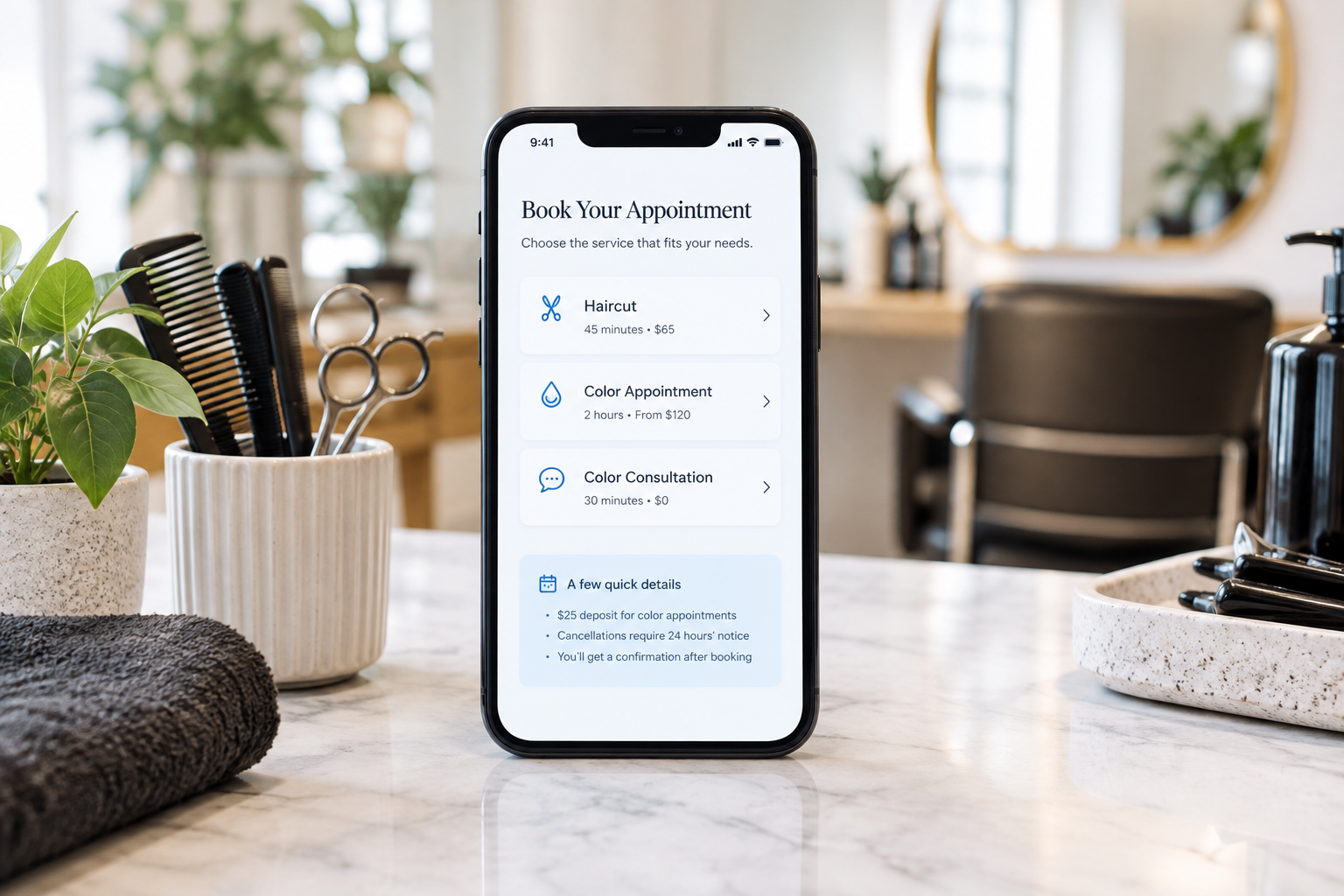
Use fixed prices when the service is standardized, the scope is easy to define, and most customers buy a similar package. This works well for services such as a basic consultation, a defined maintenance plan, a standard treatment, or a simple booking-based offering.
Be precise about what is included, what is not included, and whether taxes, travel, materials, or add-ons change the final total. A clean price without boundaries can create more confusion than no price at all.
2. Starting prices
A “starting at” price works when there is a reliable entry-level version of the service, but the final scope varies. For example: “Website projects start at [amount]” or “Weekly lawn care starts at [amount] for typical residential properties.”
Only use this approach if the starting point is real. A number that almost no customer can actually receive will damage trust quickly.
3. Price ranges
Ranges are often the best middle ground for custom service work. They show that you understand the investment question while leaving room for the variables that matter.
A useful range includes a short explanation: “Most projects fall between [amount] and [amount], depending on [two or three meaningful factors].” Keep the factors concrete. Property size, materials, number of locations, timeline, integrations, service frequency, and existing conditions are more helpful than “many variables.”
4. Pricing process and investment factors
If a range would be too broad to be useful, explain the process instead. Tell visitors what you need to prepare an estimate, when they will receive it, what happens during discovery or a site visit, and which factors influence the investment.
This is not a free pass to say “contact us for pricing” and move on. The page should still answer the buyer’s natural questions: What makes one project more expensive than another? Is there a minimum engagement? Is an estimate free? What happens after I submit a request?
Use this decision test before publishing a number
For each core service, ask these five questions.
- Is there a real minimum? If you cannot profitably take on work below a certain level, that is useful qualification information.
- Can a prospect describe the basic scope before speaking with us? If yes, a fixed price or starting price may work.
- Do most completed projects cluster within a reasonable band? If yes, a range may be more honest than a single number.
- What variables change the cost? Name the variables a customer can understand and influence.
- Would a published number cause the wrong expectation? If it would, publish the process and qualification requirements instead.
Do not make one decision for the whole company if your services behave differently. A business may publish prices for maintenance plans, ranges for common projects, and a detailed estimate process for complex commercial work.
What a helpful pricing section actually includes
Good pricing content answers more than “how much?” It reduces the awkward uncertainty around contacting a business.
- A clear label such as “Investment,” “Pricing,” “Project ranges,” or “What affects cost.”
- The price, starting point, range, or minimum where appropriate.
- A plain-language description of what is included.
- The two to four factors that most affect the final cost.
- A note about exclusions, travel, materials, permits, or ongoing fees if they are common and relevant.
- A realistic next step, such as requesting an estimate, booking a consultation, or sending project details.
- What the customer can expect after that next step.
Place this information where people need it. A general pricing page can work, but service-specific pricing guidance is often more useful. Someone researching roof repair wants cost context on the roof repair page, not a treasure hunt through the footer.
Three examples of honest pricing language
For a standardized service
Seasonal HVAC tune-ups are $[amount] per system. The visit includes a multi-point inspection, standard maintenance tasks, and a written summary of any recommended repairs. Repairs and replacement parts are quoted separately before work begins.
For a service with a dependable entry point
Landscape design plans start at $[amount]. Final pricing depends on property size, the number of areas being designed, and whether installation planning is included. We will confirm scope and provide a written proposal after the initial consultation.
For complex custom work
Commercial cleaning proposals are built around your facility, schedule, and service requirements. Pricing is influenced by square footage, cleaning frequency, building access, and specialty needs. After a walkthrough, we provide a detailed scope and proposal so you can see exactly what is included.
Notice what these examples do not do: they do not promise a number that cannot be honored, bury a qualification requirement, or make the prospect guess what happens next.
Common mistakes that make pricing content backfire
- Publishing an old price. If pricing changes frequently, assign someone ownership of reviewing it. Incorrect information is worse than limited information.
- Using vague language instead of useful context. “Competitive pricing” tells a buyer nothing.
- Showing a low starting price with no scope. This attracts attention but can create disappointment when the actual project is larger.
- Listing numbers without explaining value. A price needs a clear service description, deliverables, and relevant outcomes.
- Forgetting the next step. After reading about price, visitors should know whether to call, book, request a quote, or provide details.
- Making the form feel like a commitment. Explain whether the next step is a no-obligation estimate, paid consultation, discovery call, or site visit.
Try a small test instead of rebuilding your whole sales approach
You do not need to publish every internal rate to learn whether more transparency helps. Pick one high-demand service that generates a lot of poor-fit inquiries or repeated price questions.
Add a short investment section with either a real starting point, a range, or a clear explanation of what affects cost. Then have your team note the quality of inquiries from that service for the next several weeks. Are prospects better prepared? Are fewer conversations ending at the first price discussion? Are the questions more specific?
Also listen for the counter-signal. If qualified prospects are misunderstanding the information, the issue may be the wording or placement, not the idea of sharing it.
Pricing clarity is really conversation clarity
Customers do not expect every service business to post a neat menu of final prices. They do expect help understanding whether they should take the next step.
Give them the most honest level of context your business can support. You will make the website more useful, protect your team’s time, and create a better first conversation with people who are genuinely likely to become customers.
If your website leaves visitors unsure about your process, fit, or next step, a website review can identify where that uncertainty is costing you leads.